Work · A
Quant interview coaching and MFE admissions
One-to-one coaching from a working high-frequency trading quant, for STEM students, PhDs and early-career engineers targeting research, trading or development roles, and for applicants to MFE and MFin programmes. One hour online, £250, with your CV read first.
Practice: 1040 questions with worked solutions, including 500 quant interview questions and a timed quiz, plus coding interview practice with an editor that runs your code in six languages.
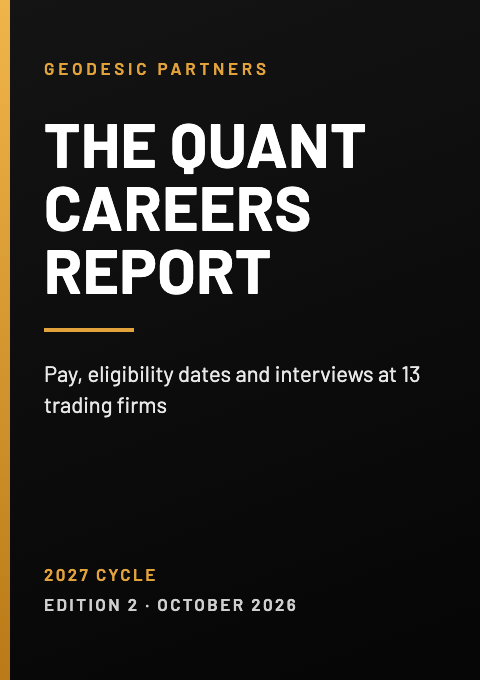
PDF · Edition 2 · £79
The Quant Careers Report
Before you apply: what 13 trading firms state they pay, the graduation dates each programme accepts, and how each one interviews, from their own adverts and careers pages.
What actually gets tested
Most candidates grind brainteaser lists and arrive at a final round assuming the test is whether they can produce the answer. What the desk is watching is how you behave in the ninety seconds after you realise you cannot.
I have sat on the receiving end of these interviews, and I have done the job they select for. The preparation is built around what the desk is actually screening:
- Probability under adversarial questioning — not the problem, but the follow-up to your answer, and the follow-up to that
- Stochastic calculus to the depth genuinely required — Itô, change of measure, martingale arguments; and the large volume of it you can safely ignore
- Market-making and pricing games — quoting under uncertainty, adverse selection, updating on order flow
- Mental arithmetic at speed — resented by every client for the first month, decisive in the second interview
- Coding screens — C++ and Python, with the performance questions that separate a developer from a scripter
- Thinking aloud — being wrong confidently, then correcting quickly. The single most common reason strong mathematicians fail final rounds.
Where the depth comes from
My research sits at the intersection of probability theory and pure mathematics, and of both with markets. Two strands: high-frequency trading, and proving correctness of algorithms — graph algorithms and greedy algorithms — using category theory. Alongside it, algebraic topology, differential geometry and stochastic analysis.
This is not decoration on a tutoring profile. It is why I can take a client to the bottom of a measure-theoretic argument or a STEP question rather than to the edge of what I remember.
The mathematics, plainly
Candidates ask what depth is actually required. This is roughly it. If these read as familiar, the preparation is about performance rather than content. If they do not, that is the gap we close first.
Ordinary calculus loses the third term. Quadratic variation does not vanish, and being able to say why in one sentence is the actual test.
Pricing is an expectation under a measure chosen to make a process a martingale. That is a convenience, not a claim about the world.
Gambler's ruin, random walks on graphs, expected time to absorption. Once you see the shape you stop solving these from scratch.
More interview probability reduces to conditioning correctly than to any other single idea. Most candidates are comfortable with it right up until it is the whole question.
Beyond this: Lévy processes, rough paths, the measure-theoretic underpinnings in depth. Enjoyable, and almost never asked. Preparing on that material is a way of doing something pleasant and calling it work.
How I can help
The strategy hour
Your CV and record read beforehand. In the hour, where you stand and honest odds at each firm you name.
£250 What the hour covers → 2The Quant Careers Report
Stated pay, eligibility dates and the interview process at 13 trading firms, with worked questions.
£79 · PDF See what is inside → 3Quant practice
Every quant question with a worked solution, timed papers, mental maths tests and the coding course.
Open to everyone Start practising →Further reading: what a quant interview is actually testing and quant interview questions with worked solutions; trader, researcher or developer, what firms pay interns, and an eight-week study plan.
Firm by firm: Jane Street, Optiver, Citadel, IMC, Five Rings, Two Sigma, D. E. Shaw, DRW, Hudson River Trading, SIG, G-Research and Flow Traders, each from what the firm itself publishes about its process.