Blog · Quant careers
The best quant interview prep for 2027
If you only buy one book, buy Xinfeng Zhou's A Practical Guide to Quantitative Finance Interviews. Add a timed question bank and ten minutes of mental arithmetic a day. What you need after that depends on the role.
I work as a high-frequency trading quant, and most lists of this kind are written by the site they end up recommending. This one has that problem too, so here it is up front: one of the practice sites below is ours, and it's marked. The rest are here because I'd point a friend at them.
The books
| Book | Best for | Watch out for |
|---|---|---|
| A Practical Guide to Quantitative Finance Interviews, Xinfeng Zhou | Your first book, for any quant role. It's known as the Green Book | Interviewers know it too, so a memorised answer won't get you far |
| Heard on the Street, Timothy Falcon Crack | A long-running collection of real-style questions | Parts of it lean towards older finance interviews |
| Quant Job Interview Questions and Answers, Mark Joshi, Nick Denson and Andrew Downes | Harder material for research and derivatives roles | Too much for most trading screens |
| Fifty Challenging Problems in Probability, Frederick Mosteller | Short problems that build instinct | Old and thin on explanation |
| Introduction to Probability, Joseph Blitzstein and Jessica Hwang | Filling real gaps in probability | A textbook, so start it early |
The practice sites
| Site | What it's good for |
|---|---|
| QuantGuide | Hundreds of questions on probability and statistics, with a large community |
| Brainstellar | Puzzles from quant interviews, sorted by difficulty |
| Zetamac | A simple arithmetic speed drill. Candidates have used it for years |
| Tradermath | Practice aimed at trading interviews |
| Academic Quant (ours) | 500 questions with worked answers, timed papers, and mental maths tests in the 80 in 8 format, with negative marking |
| LeetCode | General coding practice, which most firms test in some form |
Prices and free tiers change, so check each site before you pay for anything.
If you want a coach
Most people don't need one to start. A coach earns their fee once you know the material and want someone to find what you can't see yourself. These are worth a look, and one is ours.
| Coach | What you get |
|---|---|
| Thirty Heads | Weekly one-to-one sessions with a theoretical physicist, paid by the hour, first 15 minutes free |
| Desk2Quant | One-to-one mentoring and mock interviews, strongest on pricing, risk and bank quant roles |
| Quant Blueprint | A structured bootcamp for trading and research roles |
| Academic Quant (ours) | One hour with a working high-frequency trading quant, £250, your CV read first, with free question banks alongside |
Before paying anyone, ask who will run the sessions and what they've done themselves. Start with one session, not a package.
What to use for each role
Traders. Speed matters most. Do mental arithmetic every day, work through probability and expected value, and practise market making games out loud. The arithmetic screen ends a lot of applications early.
Researchers. Go deeper on probability and statistics, and expect machine learning and coding. Joshi's book is useful here, and so is writing models from scratch in NumPy.
Developers. The questions move to C++, memory and latency. Start with low-latency C++ questions, and keep your general coding sharp.
If you aren't sure which you want, this comparison of the three roles may help. Firm processes differ too, so read the guide for your target, such as Jane Street or Optiver.
What I'd skip
Reading solutions without trying the problem first feels productive and teaches very little. Interviews test whether you can produce an answer aloud under time pressure, so practise that way from the start. I'd also ignore any list of questions claiming to be from a recent interview at a named firm. You can't check it, and it encourages memorising.
You can find people to compare notes with on QuantNet, Wilmott and Quantitative Finance Stack Exchange. For a week-by-week order, here's an eight-week study plan.
Questions people ask
Is the Green Book enough for quant interviews?
It's enough to learn most of the question types, but not enough on its own. You also need timed practice, mental arithmetic and, for most roles, coding.
What is the best free quant interview resource?
There's no single one. For free practice, Brainstellar has puzzles, Zetamac has arithmetic drills and our question banks have worked answers. Blitzstein and Hwang's probability book is also available free online from the authors.
Who is the best quant interview coach?
There's no independent ranking, and it depends on the role. Thirty Heads suits trading interviews, Desk2Quant suits bank and pricing roles, and Academic Quant offers a single hour with a working HFT quant. Book one session first and judge from that.
How long does it take to prepare for a quant interview?
About eight weeks is a sensible target if you already have the mathematics, working most days. Start the daily arithmetic earlier if a firm screens on it.
Do I need stochastic calculus for a quant interview?
For most trading roles, very little. It matters more for derivatives research and pricing work. Check what your target role actually does before spending weeks on it.
Are paid quant interview platforms worth it?
They can be, if you've run out of free questions at your level. Start with a book and free practice, and pay only once you know what you're missing.
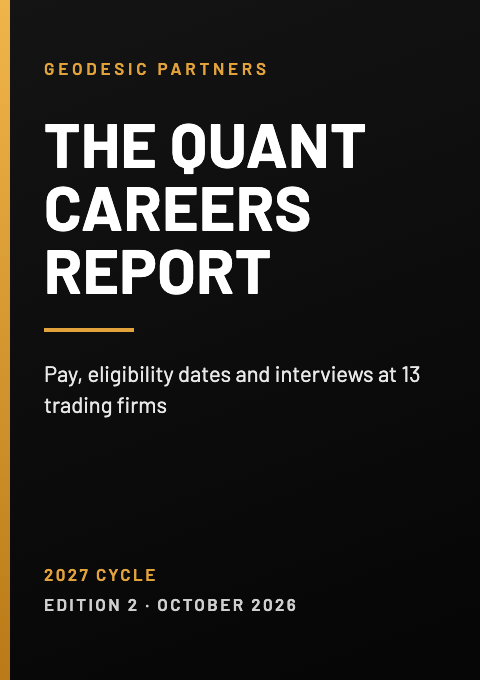
PDF · Edition 2 · £79
The Quant Careers Report
Books teach the questions. The report covers the firms: how 13 of them interview, the pay they state and when each programme takes applications.