Work · Oxbridge STEM · MAT
Oxford MAT and TMUA preparation
For 2027 entry Oxford has replaced the Mathematics Admissions Test with the TMUA. The admissions test still decides more of the Oxford outcome than anything else in the application. Here is what changed, how the two tests differ and how to prepare.
Practice: TMUA questions and 40 MAT questions with worked solutions, or a timed paper.
The MAT, and the change to the TMUA
Until 2026 entry, Oxford applicants for mathematics, computer science and their joint courses sat the MAT, a two and a half hour paper in late October. For 2027 entry Oxford no longer uses it: those applicants take the TMUA, a computer-based test run by UAT-UK and sat in October. MAT papers are still some of the best practice there is for the problem-solving the TMUA and the interview ask for.
TMUA vs MAT
| MAT | TMUA | |
|---|---|---|
| Used by Oxford | Until 2026 entry | From 2027 entry |
| Format | Paper; ten multiple-choice parts, then long questions | Computer-based; two multiple-choice papers |
| Length | Two and a half hours | 20 questions in 75 minutes, per paper |
| What stands out | Long questions that build on a first idea | Paper 2 tests logic and proof directly |
What follows describes the MAT, because its papers remain the core of preparation.
The syllabus stops at the first year of A-level. That is deliberate and it is the source of most misunderstanding about the paper. It is not a test of how much mathematics you know. It is a test of what you can do with very little.
- Question 1, ten multiple-choice parts, four marks each. Forty marks, and where most candidates lose the paper.
- Questions 2 to 5, long-form, fifteen marks each. You answer a subset depending on your course.
- No calculator. Arithmetic is part of the assessment.
Why strong students score badly
A student who has been getting full marks in school mathematics for four years often comes out of a first MAT mock somewhere in the forties, and cannot understand why.
School mathematics rewards recognition followed by execution. You identify which method a question belongs to and you carry it out carefully. The MAT is constructed specifically to defeat that, because if recognition were enough the paper would tell Oxford nothing they did not already have from predicted grades.
So the multiple-choice questions look like they want a value and actually want an observation. The cubic is odd. The answer is forced by a symmetry. Three of the five options die if you check a single boundary case. The full computation is always available and will get you there, and the time limit is set so that computation alone will not finish the paper.
The single most useful thing I tell candidates: if the algebra is getting ugly, you have missed the observation. Ugly is a signal to stop and look again, not a challenge to push through.
How to prepare
Not by working through past papers in order, which is what most preparation amounts to and which produces slow improvement at best.
- The first thirty seconds. Read the whole question, ask what would make this easy, look for the symmetry or substitution, and only then start. This sounds trivial and takes months to become automatic, because it works against years of successful training.
- Question 1 as its own discipline. Forty marks decided by elimination and estimation rather than solution.
- Long questions as a single idea. Part (i) looks trivial and is not there for the mark. It is there because what you notice while doing it is what part (iv) needs.
- Mental arithmetic. Twenty minutes a day. Resented for a month, decisive in October.
Timing
The paper sits in late October, with the UCAS deadline on 15 October. Serious candidates begin in the spring before. By summer the strong ones have been working for months.
Starting from September is still possible, but with materially less room, and the work shifts toward the interview where returns come faster.
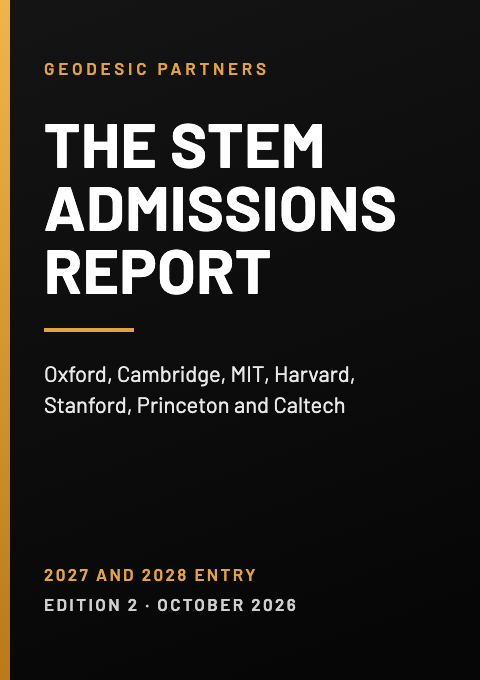
PDF · Edition 2 · £79
The STEM Admissions Report
Oxford, Cambridge, MIT, Harvard, Stanford, Princeton and Caltech: the tests, the grades, the odds by course, the deadlines, and what the degrees lead to.
Common questions
How many MAT marks did candidates need for an Oxford interview?
Thresholds move each year and by course, but historically mathematics candidates have needed the high 50s to low 70s to be shortlisted, and computer science somewhat lower. Treat any specific number you read online with suspicion; the honest answer is that it varies and the college also sees your whole application.
Can I prepare for the MAT in six weeks?
You can improve in six weeks, mostly on technique and time management. You cannot rebuild a computational reflex in six weeks, and that reflex is what the paper is built to test. Candidates who start in spring do considerably better than candidates who start in September, and the gap is not about effort.
Is the MAT harder than STEP?
No. STEP is a harder paper mathematically and sits later, after an offer. The MAT is shorter, uses less syllabus, and is testing something different: whether you can find the efficient route rather than whether you can sustain a long technical argument.
Does Oxford still use the MAT?
No. From 2027 entry, Oxford applicants for mathematics, computer science and their joint courses take the TMUA instead. MAT papers remain good practice for the problem solving both the TMUA and the interview ask for.
How do I prepare with you?
In the Oxbridge maths banks: every TMUA, STEP and MAT question with its worked solution, timed papers and Ask AI. For a view of the whole application, the strategy hour covers where the student stands.
Related
Oxbridge & US STEM admissions
The tests, the odds by course, the personal statement and the interview.
Oxbridge STEM admissions → ·STEP preparation
Cambridge mathematics papers 2 and 3, and the offer condition that catches people out.
STEP preparation → ·Reading a MAT question the way an examiner does
A longer piece on what the questions are built to detect, and how the December interview differs again.
Read the article →