Skip to content
Work Practice Products Coding interviews Machine learning coding Quant developer HFT course Blog Method Why me About Book a call

Practice · Quant prep · Expected value & market making

Expected value & market making interview questions

42 questions with worked solutions. Fair value, betting and Kelly, options intuition and quoting against informed flow.

19 easy · 22 medium · 1 hard · Question type reported at: SIG

Practise timed: 30 questions · 75s each All Quant prep topics

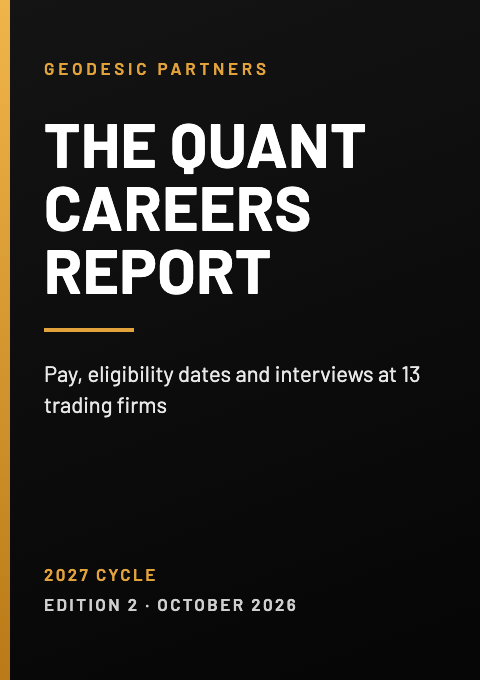
Applying to trading firms? The Quant Careers Report: what 13 firms test and pay, and when they hire. £79.


1 Easy Type asked at
You are asked to make a market on the sum of two dice. What is its fair value?
Show answer
Answer: 77
E[X+Y]=3.5+3.5\mathbb E[X+Y]=3.5+3.5. Quote around it, for example 6.5 at 7.5, and explain the width.
2 Easy Type asked at
Make a market on the product of two dice. What is the fair value?
Show answer
Answer: 12.2512.25
Independent dice: 3.5×3.53.5\times3.5.
3 Medium Type asked at
Make a market on the maximum of two dice. What is the fair value?
Show answer
Answer: ≈4.47\approx4.47
∑kk⋅2k−136=16136\sum_k k\cdot\tfrac{2k-1}{36}=\tfrac{161}{36}.
4 Easy Type asked at
Make a market on the number of heads in 10 fair tosses. What is the fair value?
Show answer
Answer: 55
Binomial mean np=10⋅12np=10\cdot\tfrac12.
5 Easy Type asked at
You pay £1 to roll a die and receive its face value in pounds. What is your expected profit?
Show answer
Answer: £2.502.50
3.5−13.5-1.
6 Easy Type asked at
A coin is tossed until the first tail; you earn £1 for every head. What is the expected payout?
Show answer
Answer: £11
The number of heads is geometric starting at 0 with p=12p=\tfrac12, mean 1−pp=1\tfrac{1-p}{p}=1.
7 Medium Type asked at
Cards are dealt from a shuffled deck until the first ace appears. What is the expected position of that ace?
Show answer
Answer: 10.610.6
The 4 aces split the 48 other cards into 5 gaps of expected size 485=9.6\tfrac{48}{5}=9.6, so the first ace is at 9.6+19.6+1.
8 Medium Type asked at
Under the Kelly criterion, what fraction of your bankroll should you stake on an even-money bet you win with probability 0.60.6?
Show answer
Answer: 20%20\%
For even odds, f∗=2p−1f^*=2p-1.
9 Medium Type asked at
A bet pays 2 to 1 and you win with probability 0.550.55. What is the Kelly fraction?
Show answer
Answer: 32.5%32.5\%
f∗=bp−qb=2(0.55)−0.452f^*=\dfrac{bp-q}{b}=\dfrac{2(0.55)-0.45}{2}.
10 Easy Type asked atSIG
An event has probability 0.20.2. What are the fair odds against it, xx to 1?
Show answer
Answer: 44 to 11
Odds against are 1−pp=0.80.2\tfrac{1-p}{p}=\tfrac{0.8}{0.2}.
11 Easy Type asked at
A stock will be 90, 100, 110 or 120 with equal probability. What is the value of a call struck at 100 (zero rates)?
Show answer
Answer: 7.57.5
Payoffs 0,0,10,200,0,10,20; average 7.57.5.
12 Medium Type asked at
With zero interest rates, S=102S=102, K=100K=100 and the call is worth 5. What is the put worth?
Show answer
Answer: 33
Put–call parity C−P=S−KC-P=S-K gives P=5−2P=5-2.

PDF · Edition 2 · £79

The Quant Careers Report

Market-making games, arithmetic screens and case studies, decoded, with how each of 13 trading firms interviews, the pay they state and when to apply.

Buy the report — £79 See what is inside

13 Medium Type asked at
You quote a market and keep getting lifted on your offer. What is the most sensible first reaction?
  1. Keep the quote; the fair value hasn't changed
  2. Move your quotes up and ask what the buyer might know
  3. Widen only the bid
  4. Stop quoting entirely
Show answer
Answer: Move up; consider adverse selection
Persistent one-way flow is information. Repricing protects you from a better-informed counterparty.
14 Easy Type asked at
A straddle struck at 100 costs 8 in total. What is its upper break-even price at expiry?
Show answer
Answer: 108108
The payoff ∣S−100∣|S-100| must cover the premium of 8.
15 Easy Type asked at
Roughly what is the delta of an at-the-money call option?
  1. 00
  2. about 0.50.5
  3. 11
  4. −0.5-0.5
Show answer
Answer: About 0.5
Roughly the probability of finishing in the money, a little above 12\tfrac12 because of drift under the pricing measure.
16 Medium Type asked at
Two fair coins are tossed and you receive the square of the number of heads. What is the expected payout?
Show answer
Answer: 1.51.5
E[H2]=Var⁡H+(EH)2=12+1\mathbb E[H^2]=\operatorname{Var}H+(\mathbb EH)^2=\tfrac12+1.
17 Medium Type asked at
Three dice are rolled. What is the expected value of the highest?
Show answer
Answer: ≈4.96\approx4.96
E[max⁡]=∑k=16P(max⁡≥k)=6−∑k=15(k6)3=6−225216\mathbb E[\max]=\sum_{k=1}^6P(\max\ge k)=6-\sum_{k=1}^{5}\left(\tfrac k6\right)^3=6-\tfrac{225}{216}.
18 Easy Type asked at
You buy 100 shares at 50.10 and sell them at 50.20. What is your P&L in pounds (ignoring costs)?
Show answer
Answer: £1010
100×0.10100\times0.10.
19 Easy Type asked at
A digital option pays £1 if a fair die shows 5 or more. What is it worth?
Show answer
Answer: £13\tfrac13
Two favourable faces out of six.
20 Medium Type asked atSIG
The "double after every loss" roulette strategy, with a finite bankroll, has expected profit:
  1. positive
  2. zero on a fair game (negative with a house edge)
  3. infinite
  4. guaranteed small and positive
Show answer
Answer: Zero (negative with an edge)
Optional stopping: no bounded strategy turns a fair game into a favourable one. Frequent small wins are paid for by rare ruin.
21 Easy Type asked at
A policy covers a loss of £5000 that happens with probability 1%. What is the actuarially fair premium?
Show answer
Answer: £5050
0.01×50000.01\times5000.
22 Easy Type asked at
A bet pays 3 to 1. What probability of winning makes it break even?
Show answer
Answer: 0.250.25
3p=1−p3p=1-p.
23 Easy Type asked at
You stake £100 at even money on a coin that lands heads 60% of the time. What is your expected profit?
Show answer
Answer: £2020
0.6⋅100−0.4⋅1000.6\cdot100-0.4\cdot100.
24 Medium Type asked at
Daily volatility is 1%. Roughly what is annual volatility over 252 trading days, in %?
Show answer
Answer: ≈15.9%\approx15.9\%
Variance adds over independent days, so volatility scales with 252\sqrt{252}.
25 Medium Type asked at
A game pays £10 on a six and nothing otherwise, and a market maker quotes 1.40 at 1.80 on it. At which price do you trade, and do you buy or sell?
  1. Buy at 1.80
  2. Sell at 1.40
  3. Buy at 1.40
  4. Don't trade
Show answer
Answer: Don't trade
Fair value is 106≈1.67\tfrac{10}{6}\approx1.67, inside the market. Buying at the 1.80 offer overpays and selling at the 1.40 bid undersells, so neither trade has positive expectation. (You cannot buy at the bid.)
26 Easy Type asked at
A die is rolled once and you are paid £10 if it shows a six. What is the fair value of the bet, in pounds?
Show answer
Answer: £1.67
16×10\tfrac16\times10.
27 Easy Type asked at
A market is 99.98 bid, 100.02 offered. What is the round-trip cost of buying and immediately selling 500 units, in pounds?
Show answer
Answer: £20
You cross the spread of 0.04 once: 0.04×500=200.04\times500=20.
28 Medium Type asked at
Roughly what is the delta of an at-the-money call with a short time to expiry?
  1. 0
  2. 0.25
  3. 0.5
  4. 0.75
  5. 1
Show answer
Answer: C. 0.5
The option is about as likely to finish in the money as out, so the delta sits near a half. It moves towards 1 as the option goes deeper in the money.
29 Medium Type asked atSIG
With interest rates at zero, a one-year call struck at 100 on a stock trading at 100 is worth 8. What is the put worth?
Show answer
Answer: 88
Put–call parity: C−P=S−Ke−rT=0C-P=S-Ke^{-rT}=0 when S=KS=K and r=0r=0.
30 Medium Type asked at
Under the Kelly criterion, what fraction of your bankroll should you stake on an even-money bet you win with probability 0.55?
Show answer
Answer: 0.10.1
For even money, f∗=2p−1=0.10f^*=2p-1=0.10.
31 Easy Type asked at
You quote 99 bid, 101 offered in a contract and are lifted twice for one lot each. What is your position?
  1. Long 2
  2. Long 1
  3. Flat
  4. Short 1
  5. Short 2
Show answer
Answer: E. Short 2
Being lifted means someone bought at your offer, so you sold: two lots short, at 101.
32 Medium Type asked at
A bookmaker offers decimal odds of 1.9 on both sides of a fair coin toss. What is the overround, as a percentage?
Show answer
Answer: ≈5.26%\approx5.26\%
Implied probabilities are 11.9\tfrac1{1.9} each, totalling 21.9=1.0526\tfrac2{1.9}=1.0526: 5.26% above certainty. That margin is the bookmaker's edge.
33 Easy Type asked at
A bet wins or loses £1 with equal probability. What is the variance of the outcome?
Show answer
Answer: 11
The mean is 0 and the square of the outcome is always 1, so the variance is 1.
34 Medium Type asked at
A stock is 50. You are long 200 shares and short 4 call options, each on 100 shares, with delta 0.4. What is your net delta, in shares?
Show answer
Answer: 4040
Short calls give −4×100×0.4=−160-4\times100\times0.4=-160 deltas, so the net is 200−160=40200-160=40 shares.
35 Medium Type asked at
Make a market on the sum of the two highest of three fair dice. What is the fair value?
Show answer
Answer: 20324≈8.46\tfrac{203}{24}\approx8.46
The sum of all three is 10.5 on average, and the lowest averages 4924≈2.04\tfrac{49}{24}\approx2.04 (sum P(min⁡≥k)=(7−k6)3P(\min\ge k)=\left(\tfrac{7-k}6\right)^3 over kk). So 10.5−2.04≈8.4610.5-2.04\approx8.46. Quote around it, say 8–9, and tighten if the other side trades.
36 Medium Type asked at
A stock is at 100 and in one year will be either 130 or 90. Interest rates are zero, and analysts give the up move a probability of 0.8. What is a one-year call struck at 100 worth?
Show answer
Answer: 7.57.5
Price by replication, not by the analysts' probability. The risk-neutral probability of the up move makes the stock a fair bet: 100=130q+90(1−q)100=130q+90(1-q), so q=0.25q=0.25. The call pays 30 or 0, so it is worth 0.25×30=7.50.25\times30=7.5. Using 0.8 gives 24, which a trader could arbitrage by selling the call and buying 0.75 shares.
37 Hard Type asked at
A stock is worth 60 or 40 with equal probability, and only you as market maker don't know which. 20% of the traders who come to you know the true value and buy only when it is 60; the rest buy or sell at random with equal probability. At what offer price do you break even on the trades that buy from you?
Show answer
Answer: 5252
Set the offer at the expected value given that someone buys. If the value is 60, a buy comes with probability 0.2+0.8×0.5=0.60.2+0.8\times0.5=0.6; if it is 40, with probability 0.8×0.5=0.40.8\times0.5=0.4. So E[V∣buy]=60×0.6+40×0.40.6+0.4=52\mathbb E[V\mid\text{buy}]=\tfrac{60\times0.6+40\times0.4}{0.6+0.4}=52. By symmetry the bid is 48. The spread pays for the informed traders.
38 Medium Type asked at
A strategy has an annualised Sharpe ratio of 2 and its annual returns are roughly normal. Approximately what is the probability that it loses money in a given year? Give a percentage.
Show answer
Answer: ≈2.3%\approx2.3\%
A Sharpe ratio of 2 means the mean annual return is two standard deviations above zero. A loss needs a draw more than 2 standard deviations below the mean: P(Z<−2)≈2.3%P(Z<-2)\approx2.3\%, roughly one year in 44. At a Sharpe of 1 the same calculation gives about 16%, one year in six.
39 Medium Type asked at
You roll a fair die and are paid its face value in pounds. You may pay £1 to roll once more, in which case you must accept the second roll. Playing optimally, what is the game worth?
Show answer
Answer: 236≈3.83\tfrac{23}6\approx3.83
Rerolling is worth 3.5−1=2.53.5-1=2.5, so reroll on a 1 or a 2 and keep 3 or more. Value: 26×2.5+16(3+4+5+6)=56+3=236\tfrac26\times2.5+\tfrac16(3+4+5+6)=\tfrac{5}{6}+3=\tfrac{23}6.
40 Medium Type asked at
A book's daily P&L is normally distributed with mean 0 and standard deviation £10,000. What is its one-day 99% value at risk, to the nearest £100?
Show answer
Answer: ≈£23,300\approx£23{,}300
The 99% quantile of the standard normal is 2.326, so the loss exceeded on 1 day in 100 is 2.326×£10,000≈£23,3002.326\times£10{,}000\approx£23{,}300. Using 1.96 gives the 97.5% figure, not the 99%.
41 Easy Type asked at
An option pays max⁡(X−3, 0)\max(X-3,\,0) pounds, where XX is the roll of a fair die. What is it worth?
Show answer
Answer: £1£1
It pays 1, 2 or 3 on a roll of 4, 5 or 6, and nothing otherwise: 1+2+36=1\tfrac{1+2+3}6=1. It is a call struck at 3 on a die.
42 Medium Type asked at
You win £2 on heads and lose £1 on tails with a fair coin, and play 100 times. What is the standard deviation of your total winnings?
Show answer
Answer: £15£15
One play has mean £0.50 and E[X2]=4+12=2.5\mathbb E[X^2]=\tfrac{4+1}2=2.5, so variance 2.5−0.25=2.252.5-0.25=2.25 and standard deviation 1.5. Over 100 independent plays the variance is 225 and the standard deviation £15. Expected total: £50, so a loss after 100 plays is more than three standard deviations away.

One round of the quoting game played out with numbers, including how an informed counterparty should change your width: the market-making interview game.

Keep practising

Want someone to work through these with you? Quant interview preparation, one to one, or book a free 20-minute call.